
The Orange Earbuds and What They Signalled
Sony Ericsson launched the W800 in mid-2005, positioning it explicitly under the Walkman sub-brand that Sony had spent two decades making synonymous with portable audio. The handset arrived in a deliberate livery — Energetic Orange, with earbuds to match — that announced its priorities before any spec sheet was consulted. This was not a phone that happened to play music. It was, Sony Ericsson insisted, a music player that happened to make calls.
The W800 supported AAC and MP3 playback at a time when many rival handsets were still routing audio through the same low-fidelity pipeline used for ringtone preview. It shipped with a 512 MB Memory Stick Pro Duo card — enough for roughly 150 compressed tracks at standard bitrates — and its dedicated Walkman key, mounted on the casing rather than buried in a menu, allowed a user to launch the media player without unlocking the phone. The bundled HPM-70 stereo headset, with its orange cable, was good enough to invite direct comparison with standalone music devices. That comparison was the point.
In 2005 the global ringtone market was approaching its peak revenue ↗, with Gartner and Nielsen both recording sustained growth in premium-SMS tone sales across Europe and North America. Carriers and aggregators — Jamba, Jamster, VeriSign's Zingy service — had built profitable businesses on monophonic and polyphonic tones sold via WAP pages and short-code SMS. The truetone, a segment of an actual master recording sold as an audio file rather than a synthesised melody, was beginning to displace MIDI-based formats as the premium product. Into this environment, the W800 introduced something awkward for the ringtone economy: a handset designed around audio fidelity that made the tinny speaker tones already on the market sound worse by contrast.

Timeline
- 2004Motorola Razr V3 launches; design-led phone, minimal audio focus
- Mid-2005Sony Ericsson W800 launches under Walkman sub-brand, bundled with HPM-70 orange headset and 512 MB Memory Stick Pro Duo
- 2005Nokia N70 released; multimedia focus on camera, secondary on music
- 2007iPhone launch enables sideloaded audio as ringtone; paid-tone market begins structural decline
A Handset Among Its Contemporaries
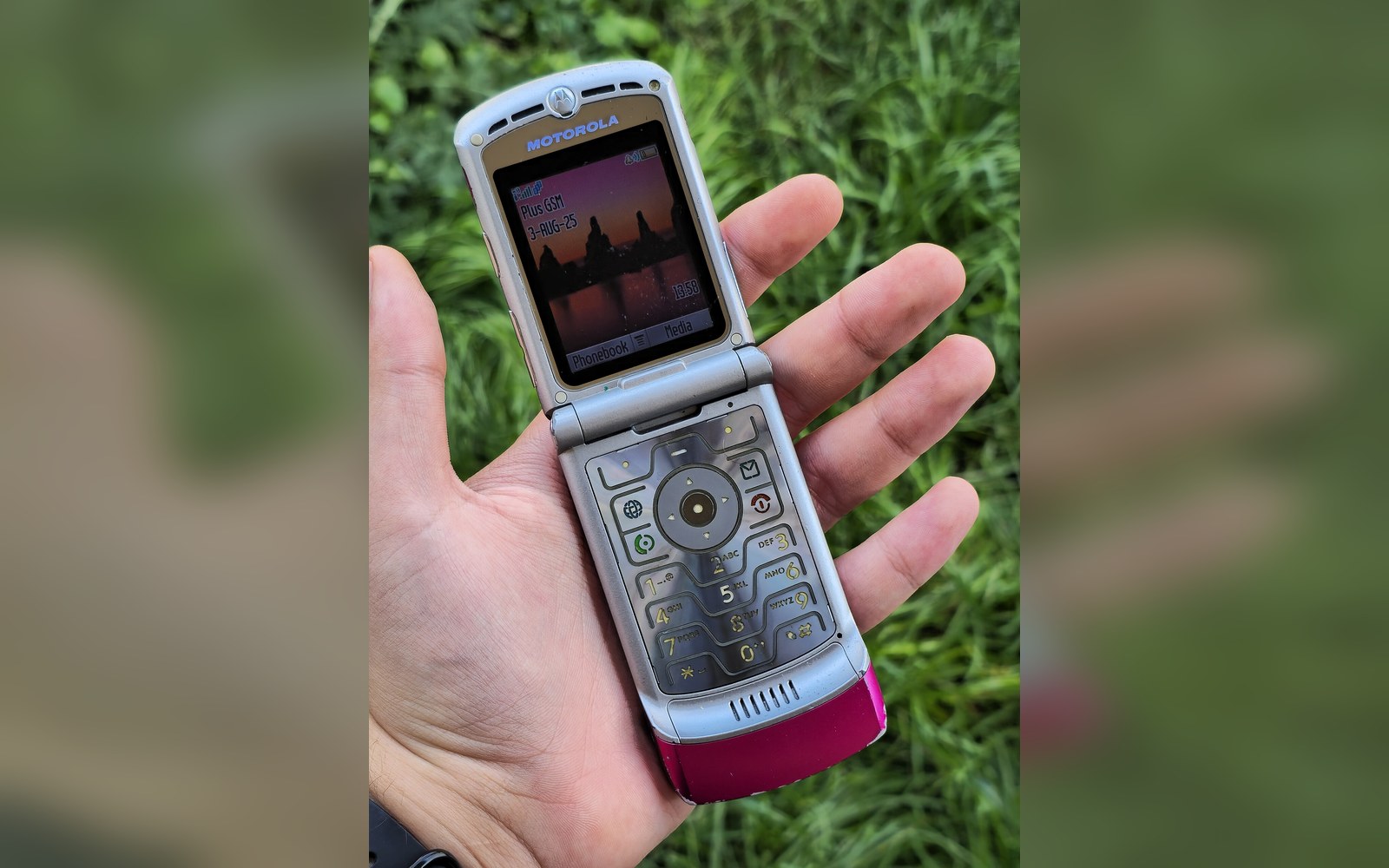
The rivals at the same moment each made a different calculation. Nokia's N70, released the same year, was a multimedia device with a 2-megapixel camera at its centre; its music credentials were secondary, its default ringtones a carry-over from the established polyphonic library. The Motorola Razr V3, already in market since late 2004, had become a sales phenomenon on the strength of its industrial design — a 13.9 mm-thin clamshell — but its audio chain was unremarkable and its music interface minimal. Samsung's mid-range 2005 offerings similarly treated audio as a feature among features rather than a defining characteristic.
The W800 was benchmarked at launch against the iPod mini as much as against any phone. Apple's iPod had established an expectation ↗ of clean, uncompressed-feeling audio and tactile simplicity in a dedicated music device; Sony Ericsson's argument was that the gap between a phone and a player was now closeable. The argument was partly true. The W800's audio output measured better than its contemporaries in independent reviews, and the Walkman key workflow held up in practice.
Where the device fell short of a true convergence pitch was storage: 512 MB was meaningful in 2005 but already a limit against a 4 GB iPod mini, and the Memory Stick Pro Duo format — proprietary to Sony — imposed a cost ceiling on expansion. The phone ran on Sony Ericsson's proprietary feature-phone platform rather than Symbian, and multitasking between a music playback session and other functions was imperfect.
For the ringtone market specifically, the W800 mattered in two ways. First, it set a precedent that audio quality was a valid handset selling point — that consumers would pay attention to how a phone sounded, not merely how it looked. Second, its support for standard audio file formats meant a user could, without purchasing through a carrier portal, transfer an MP3 and set a portion of it as a ringtone: an early glimpse of the sideloading behaviour that the iPhone would formalise in 2007 and that would help hollow out the paid-tone market within three years of the W800's debut.
The orange earbuds were a marketing choice. What they advertised turned out to be a structural shift.
Samsung's mid-range 2005 offerings similarly treated audio as a feature among features rather than a defining characteristic.
Formats and specs
- AAC — Advanced Audio Coding, the file format the W800 supported alongside MP3; higher quality per kilobit than its MP3 equivalent
- Memory Stick Pro Duo — Sony's proprietary flash card format, used for storage expansion on the W800
- Walkman key — a dedicated hardware button on the W800 casing giving one-press access to the media player without unlocking the phone
- HPM-70 — model designation for the bundled Sony Ericsson stereo headset shipped with the W800 in its Energetic Orange colourway